
RAG Explained for Business Teams
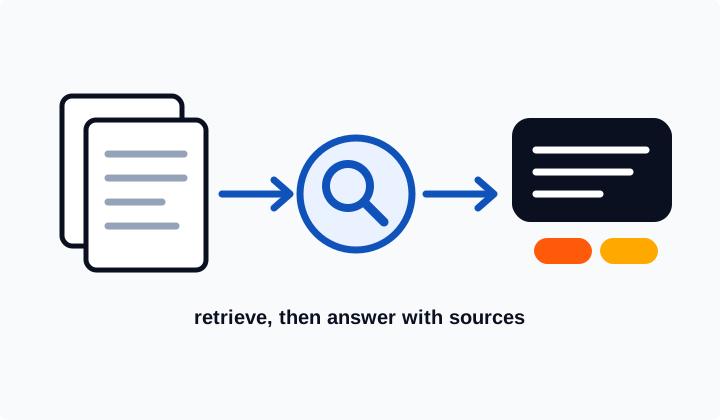
Retrieval-augmented generation, usually shortened to RAG, is the most common way businesses put AI assistants to work on their own information: policies, product manuals, contracts, support tickets. It is also widely misunderstood. This guide explains what RAG does, why it is usually a better first step than training a custom model, and what separates a helpful assistant from one that confidently gives the wrong answer.
The problem RAG solves
A large language model learns from public text up to a point in time. It does not know your price list, last month’s policy change or the details of a customer’s contract. Ask it anyway and it may produce an answer that sounds right but is invented.
RAG fixes this by giving the model the relevant facts at the moment it answers. Instead of relying on what the model remembers, the system first looks up the most relevant passages in your documents, then asks the model to answer using only those passages, and to say which ones it used.
How it works, step by step
Behind the chat box, a RAG system runs two separate processes. The first prepares your documents ahead of time. The second runs each time someone asks a question.
- Collect: gather the documents the assistant may use, and record who is allowed to see each one
- Split: break long documents into passages of a few paragraphs, keeping headings so each passage still makes sense on its own
- Index: convert each passage into an embedding, a list of numbers that captures its meaning, and store it in a vector index alongside a normal keyword index
- Retrieve: when a question arrives, find the passages whose meaning is closest to the question, combined with keyword matches for exact terms like product codes
- Answer: send the question and the best passages to the language model with instructions to answer only from them and cite its sources
- Check: show the sources to the user, and log the question, passages and answer so the team can review quality
Why not train a model on our data?
Fine-tuning changes how a model writes and behaves. It is useful for tone, format or a specialised task, but it is a poor way to teach facts that change. Every policy update would need another training run, and you still could not see which document an answer came from.
With RAG, updating knowledge means updating the documents. The answer can point to its source, and access rules can be applied before anything reaches the model. For most business assistants, RAG is cheaper, faster to change and easier to audit. Fine-tuning can come later if the assistant needs a particular style.
What makes the answers trustworthy
Most RAG projects that disappoint fail at retrieval, not at the AI model. If the right passage never reaches the model, even the best model cannot answer correctly. Good systems spend real effort on the unglamorous parts.
- Clean sources: remove outdated versions and duplicates so the assistant cannot quote a superseded policy
- Sensible passages: split on headings and sections, not at a fixed number of characters in the middle of a table
- Hybrid search: combine meaning-based search with keyword search so names, codes and numbers are found reliably
- Permissions: filter passages by the user’s access rights before retrieval, never after the answer is written
- Citations: show which documents each answer used so people can check, and say “I don’t know” when nothing relevant is found
Measure it before you trust it
Before launch, write down 50 to 100 real questions with the answers your experts would give, including some that the documents cannot answer. Run them through the assistant and score two things separately: did it find the right passages, and did it answer correctly from them? This tells you whether to fix the search or the prompt.
Keep the test set and rerun it whenever documents, prompts or models change. After launch, review a sample of real conversations each week, and give users a quick way to flag a bad answer.
Keep a person in the loop where it matters
For internal questions such as “What is our travel policy for client visits?”, a cited answer is often enough. For anything that reaches a customer or changes a record, such as a refund decision or a contract clause, the assistant should draft and a person should approve. This keeps speed where it is safe and judgement where it is needed.
Questions to ask before you build
Clear answers to these questions make a RAG project faster and far more likely to succeed.
- Which decision or task will the assistant speed up, and how will we measure it?
- Which documents are the source of truth, and who keeps them current?
- Who may see which documents, and how is that recorded today?
- What should happen when the assistant is not confident?
- Which answers need human approval before they are used?
Related service: AI automation, RAG and AI agent development
Have a product or automation challenge?
Share the business goal with Puzji and we will help identify a practical product, AI, integration, or cloud delivery path.
Plan the next step