
Next.js or a Single-Page App? How to Choose
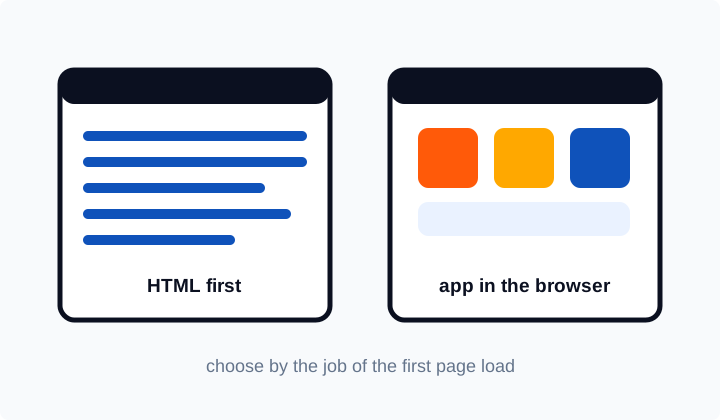
Teams starting a new web product often ask whether to use Next.js or build a single-page app (SPA) with a tool like Vite. Both are built on React, and both can produce fast, good-looking products. The right choice depends on what the first page load must do, how much of the site needs to be found in search, and where the product will run. We use both at Puzji, and the reasons are a useful guide.
What actually differs
A single-page app sends the browser a nearly empty HTML page and a bundle of JavaScript. The JavaScript then builds the page on the visitor’s device. After the first load, moving between screens is instant because nothing new needs to come from the server.
A server-rendering framework like Next.js produces the HTML for each page ahead of time or on the server, so the first response already contains the content. JavaScript then takes over for interactive parts. Pages are readable before any script runs, which helps search engines, link previews and slow devices.
Example 1: puzji.com is built with Next.js
Our company site is mostly content: services, products, articles and job openings. Every page needs to be found in search and to show a proper preview when shared. Most pages never change between visits.
Next.js lets us generate nearly every page as static HTML at build time, with its own title, description, canonical address and structured data. Visitors get content immediately, and interactive parts such as the product stack in the hero load on top. Redirects and URL clean-up run in a small proxy layer, so old addresses go to the right place.
Example 2: Puzji Games is a single-page app
Puzji Games is the opposite. Once loaded, it is an application: boards are generated on the device, players drag paths and tap cells, and moving between games should feel instant. It also needs to work offline, so the whole app is cached by a service worker after the first visit.
A Vite single-page app fits this well. There is no server rendering to keep running, the build is plain static files on a CDN, and the game logic lives in a shared package that the web app imports.
We did not give up on search, though. At build time, a script writes each game’s rules, strategy guide and questions into the HTML of that game’s page, so search engines and visitors without JavaScript still see real content. The app replaces it when it starts. This keeps the simplicity of a single-page app while avoiding its biggest weakness.
A simple way to decide
Look at the first visit to your most important page and ask what it must achieve.
- Most visitors arrive from search or shared links: prefer server rendering or static generation
- Content changes often and must be fresh for every visitor: server rendering with caching
- The product is used after sign-in, like a dashboard or editor: a single-page app is usually simpler
- It must work offline or behave like an installed app: a single-page app with a service worker
- You need both, like a marketing site and an app: build them separately, or use Next.js for both with client-side screens where needed
Costs people forget
Server rendering means a server or edge runtime to operate, monitor and pay for, unless pages can be fully static. It also brings a learning curve: knowing which code runs on the server, which in the browser, and what gets cached where.
Single-page apps push work onto the visitor’s device. On a budget phone, a large bundle can delay the first useful screen by seconds. Keep bundles small, split code by route, and measure on real mid-range devices, not just a developer laptop.
Our recommendation
Choose by the job of the first page load, not by habit. Content that needs to be found should arrive as HTML. Applications that live behind a login or work offline can be single-page apps. When a product has both, it is fine to use two tools, and many successful products do exactly that.
Related service: Web application development
Have a product or automation challenge?
Share the business goal with Puzji and we will help identify a practical product, AI, integration, or cloud delivery path.
Plan the next step